

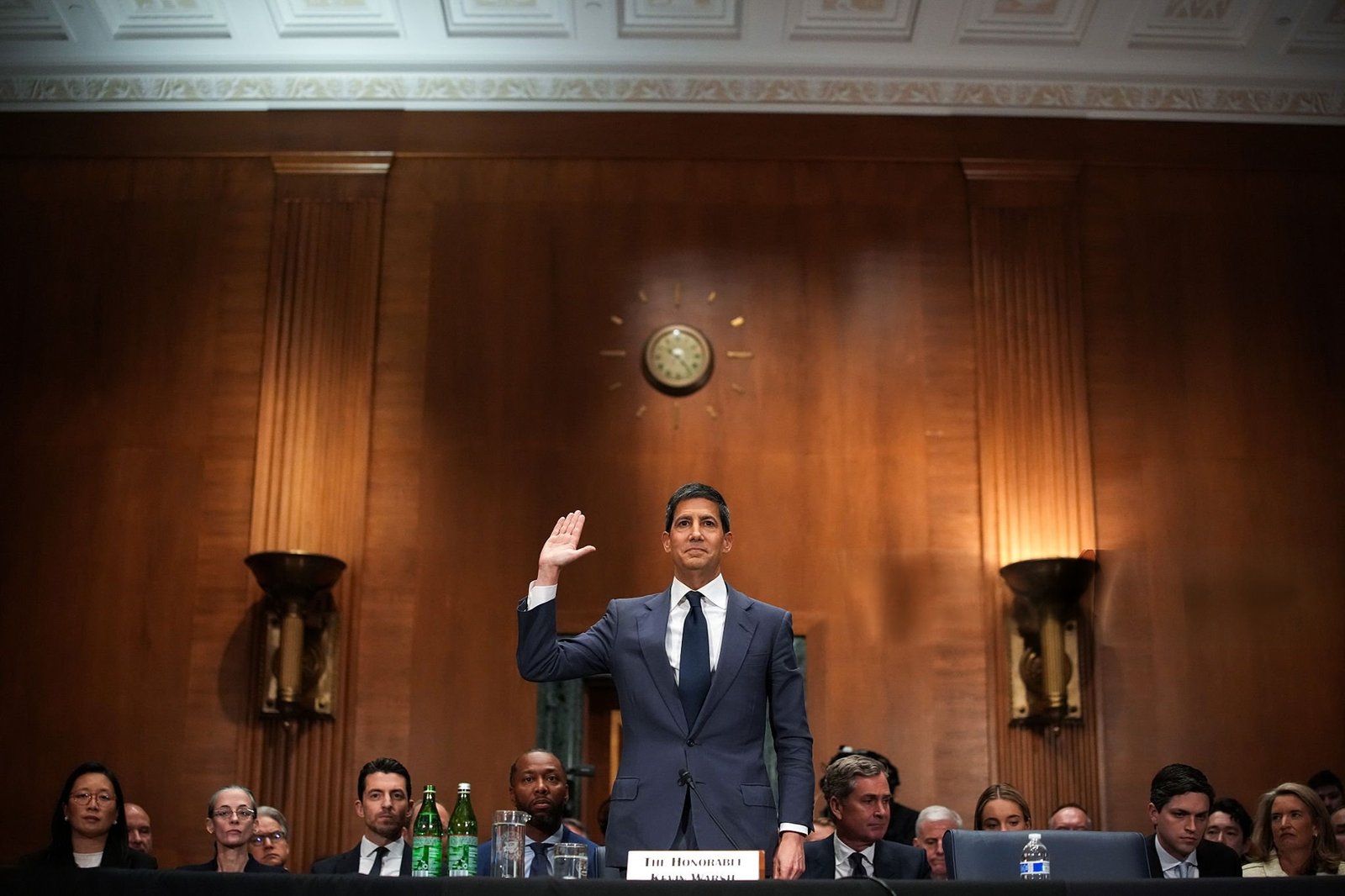
In recent weeks, the conversation around who might lead the Federal Reserve has shifted from speculation to something more concrete. Kevin Warsh is now widely expected to take on the role, stepping into a central bank that is far more divided, and far more constrained, than it was just a few years ago.
It is tempting to focus on the individual. Warsh’s past speeches, his voting record, his preferences. But central banking does not change because of one person alone. It changes when the underlying way of thinking shifts. That is where this moment becomes more interesting. Markets are not just watching who takes the chair. They are trying to work out whether the Fed itself is about to think differently.
A Shift in Priorities: Inflation, Growth, and the Size of the Fed
At the core of monetary policy is a simple but difficult trade-off. Bringing inflation down often requires slower growth or weaker hiring, while supporting the economy can allow price pressures to persist. Where a central bank chooses to sit along that trade-off tells you a great deal about how it thinks.
In recent years, the Federal Reserve has leaned toward flexibility. After the pandemic, policymakers were willing to tolerate higher inflation for a period in order to support the recovery. That approach ultimately gave way to one of the fastest tightening cycles in decades when inflation proved more persistent than expected. Even now, inflation remains above target, keeping that tension between price stability and growth firmly in place.
Kevin Warsh’s record suggests a different weighting of that balance. His public comments and past decisions point to a stronger emphasis on inflation risks and the importance of credibility. That does not mean ignoring growth altogether, but it does imply a lower tolerance for letting inflation drift in the hope that it will resolve on its own. The practical effect of that shift is not dramatic in isolation, but it changes the threshold for action. Rate cuts become harder to justify, and policy is less likely to ease at the first signs of economic weakness.
Where this becomes more interesting is in how that philosophy extends beyond interest rates. Warsh has consistently argued that monetary policy is not just about the level of rates, but also about the size and role of the central bank itself. In particular, he has been critical of the Federal Reserve’s balance sheet, which expanded significantly through years of bond-buying programmes and still remains elevated even after recent reductions.
His concern is not purely technical. He has argued that a persistently large balance sheet can distort financial markets, influence asset prices, and potentially contribute to inflationary pressures over time. The implication is that monetary policy has become too reliant on expanding the central bank’s footprint, rather than operating through more traditional tools.
This leads to a different way of thinking about policy. Instead of relying heavily on asset purchases and a large stock of holdings, the preference shifts toward a smaller balance sheet and a greater emphasis on interest rates as the primary tool. Warsh has suggested that reducing the balance sheet should go hand in hand with rate decisions, rather than being treated as a separate or secondary process.
However, this is where the theory runs into practical constraints. The Federal Reserve’s balance sheet has already been reduced by more than $2 trillion since 2022, yet financial conditions have not tightened as much as many expected. The modern financial system now relies on a high level of reserves, and shrinking the balance sheet too aggressively risks disrupting funding markets or reducing the Fed’s control over interest rates.
Even Warsh himself has acknowledged that any reduction would need to be gradual and carefully managed. That tension is important. It highlights that the debate is not simply about whether the balance sheet should be smaller, but about how far it can realistically be reduced without creating new risks.
Taken together, this points to a broader shift in priorities. It is not only about being stricter on inflation. It is about redefining the role of the central bank, moving toward a model that does less through its balance sheet and relies more heavily on conventional policy tools. That shift, if it materialises, would shape how policy is delivered just as much as the decisions themselves.
The Reaction Function
Central banks are often described in terms of their targets, but just as important is how they respond to incoming data. Economists call this the “reaction function”. It is the internal logic that determines how quickly policy changes when the economy moves.
In recent years, the Fed has leaned toward a more cautious, data-dependent approach. Policymakers have waited for clearer evidence before acting, particularly after being criticised for moving too slowly on inflation earlier in the cycle. That caution is visible today in the reluctance to cut rates despite signs of slowing momentum.
A shift in thinking could change that timing. A Fed that places more weight on inflation risks may act earlier, tightening policy pre-emptively rather than waiting for inflation to fully materialise. At the same time, it may delay rate cuts even as growth weakens, requiring stronger evidence that inflation is under control.
This is not theoretical. The current Fed is already showing signs of internal disagreement, with recent decisions producing the most divided votes in decades. Warsh himself has indicated that he expects more debate within the committee, describing the policymaking process as one that should involve a “family fight” rather than consensus for its own sake.
The result is a more uncertain path for policy. Decisions become less predictable, and markets are forced to respond more directly to economic data rather than relying on a clear, steady signal from the central bank.
How the Fed Speaks
If interest rates are the visible part of monetary policy, communication is the mechanism that moves markets ahead of those decisions. Forward guidance, press conferences, and official statements shape expectations long before any rate change actually happens.
This is another area where a shift could emerge. Warsh has been critical of the Fed’s reliance on forward guidance and its broader communication strategy. He has argued that excessive signalling can create complacency in markets, encouraging investors to rely on central bank support rather than underlying economic conditions.
That critique matters because it challenges a key feature of modern central banking. Over the past decade, the Fed has placed increasing emphasis on transparency and guidance, using communication as a tool to stabilise markets. If that approach is scaled back, the consequences are immediate.
Markets would receive fewer clear signals about the future path of rates. Expectations would become more sensitive to each data release. Volatility would increase, not necessarily because policy is more aggressive, but because it is less clearly communicated in advance.
There is already evidence that communication is becoming a point of tension within the Fed. Disagreements over a single line in policy statements have been enough to trigger dissent among policymakers, particularly when that language shapes expectations about future rate cuts.
A change in communication style may sound technical, but it directly affects how financial conditions evolve. When expectations shift, markets move. When markets move, borrowing costs and asset prices follow.
What This Means for You
For most people, central banking feels distant. Decisions made in Washington do not immediately connect to everyday choices. But the transmission is more direct than it appears.
If interest rates stay higher for longer, borrowing becomes more expensive. Mortgage rates remain elevated, making it harder to buy or refinance a home. Businesses face higher financing costs, which can slow hiring and investment. At the same time, savers may benefit from higher returns on deposits and fixed-income assets.
A more pre-emptive approach to policy means the economy may slow earlier in the cycle, even before inflation becomes a visible problem. That can show up in the job market, where hiring becomes more cautious. It can also affect financial markets, where asset prices adjust more quickly to changing expectations.
Changes in communication matter as well. If the Fed provides less forward guidance, markets become more reactive. That can lead to sharper moves in interest rates, equities, and currencies, even in response to relatively small pieces of data.
The important point is that none of this requires a dramatic policy shift. Even a subtle change in how the Fed prioritises inflation, responds to data, or communicates its intentions can reshape the environment that households and businesses operate in.
And that process does not wait for official announcements. Markets begin adjusting as soon as they sense a change in direction.
💼 Unpacked
Reaction Function
A central bank’s reaction function describes how it adjusts interest rates in response to changes in inflation, growth, and employment. It reflects the underlying strategy guiding decisions, including how quickly policymakers act and which risks they prioritise when economic conditions shift.
Forward Guidance
Communication from a central bank about the likely future path of interest rates, used to influence market expectations before policy changes occur.
Central Bank Balance Sheet
The central bank’s balance sheet shows the assets it holds, mainly government bonds, and the money it has created to buy them. Expanding it adds liquidity to the financial system, while reducing it withdraws liquidity and can push up longer-term interest rates.
Hawkish vs Dovish
A hawkish central bank prioritises controlling inflation, often favouring higher interest rates even if growth slows. A dovish stance places more weight on supporting growth and employment, accepting lower rates and a higher tolerance for inflation in the short term.
📣 Support The Fiscal Compass
If you found this insightful, consider sharing with friends or colleagues. For weekly economics-led takes on markets, policy, and macro trends, subscribe to The Fiscal Compass.
Follow along on social media for concise updates throughout the week:
Instagram: @thefiscalcompassofficial
X: @FiscalCompass.
LinkedIn: Vinay Meisuria
Primary Sources
- “Recent inflation data was ‘bad news,’ Fed’s Goolsbee says” — Reuters
https://www.reuters.com/business/recent-inflation-data-was-bad-news-feds-goolsbee-says-2026-05-02/ - “Warsh May Be Tested Early. It All Depends on Hormuz.” — Barron’s
https://www.barrons.com/articles/warsh-may-be-tested-early-it-all-depends-on-hormuz-97dfcaaf - “After Months of Debating Rate Cuts, Fed Shifts Toward Mapping Out Hikes” — Wall Street Journal
https://www.wsj.com/economy/central-banking/after-months-of-debating-rate-cuts-fed-shifts-toward-mapping-out-hikes-db850f74 - “Fed’s policymaking table is set for the ‘family fight’ Warsh says he wants” — Reuters
https://www.reuters.com/business/feds-policymaking-table-is-set-family-fight-warsh-says-he-wants-2026-04-28/ - “What Kevin Warsh’s Confirmation Hearing Revealed About the Future of the Fed” — Council on Foreign Relations
https://www.cfr.org/articles/what-kevin-warshs-confirmation-hearing-revealed-about-the-future-of-the-fed - “Kevin Warsh’s tenure as Fed governor shaped by inflation concerns” — Yahoo Finance
https://finance.yahoo.com/news/kevin-warshs-tenure-as-fed-governor-shaped-by-inflation-concerns-central-bank-credibility-182659155.html - “Why An Inflation Hawk Like Kevin Warsh Might Lower Interest Rates” — Forbes
https://www.forbes.com/sites/billconerly/2026/02/10/why-an-inflation-hawk-like-kevin-warsh-might-lower-interest-rates/ - “What Could the Fed Look Like Under Kevin Warsh?” — Conference Board
https://www.conference-board.org/podcasts/c-suite-perspectives/What-Could-the-Fed-Look-Like-Under-Kevin-Warsh - “What Are Trimmed Mean and Median Inflation Rates?” — Brookings Institution
https://www.brookings.edu/articles/what-are-trimmed-mean-and-median-inflation-rates-and-why-does-kevin-warsh-prefer-them/