


What will be the response to the US strikes on Venezuela? In the UK the gap between market performance and economic reality is becoming more pronounced. And global competition is hitting the EV industry. This piece explores these three stories, and how they could impact daily life.
🇺🇸🇻🇪 The Economic Impact of US Strikes on Venezuela
The US strikes on Venezuela have reintroduced a familiar vulnerability into global markets: oil supply risk. Venezuela holds the world’s largest proven oil reserves, but years of underinvestment and sanctions have already limited output. Any further disruption raises concerns about how tight global energy markets could become if conditions deteriorate.
Venezuela sits on one of the largest concentrations of proven oil reserves in the world, estimated at roughly 303 billion barrels, or around 17 % of global proven crude reserves according to OPEC and U.S. Energy Information Administration data. Despite this vast endowment, constrained production reflects years of underinvestment, infrastructure decay, and sanctions that have limited output and export capacity.
The recent strikes have heightened uncertainty about how these reserves could be developed, who will control future revenue flows, and how sanctions policy might evolve. This uncertainty matters because markets must reassess future supply expectations and legal and political risks before pricing in any meaningful shift in global energy balances
For financial markets, the immediate reaction may appear muted. Investors often wait for evidence of actual supply losses rather than reacting to headlines alone. For households, the impact is more direct. Oil prices feed into fuel costs, transport prices, and eventually household bills. Energy shocks tend to affect lower-income households the most and may complicate the task facing central banks trying to stabilise prices.
Markets may remain calm, but energy remains one of the fastest channels through which global tensions can spill into everyday economic life.
🇬🇧 FTSE 100 Hits a Record 10,000
The FTSE 100 crossing the 10,000 mark is a symbolic milestone for UK markets, but it has also raised an obvious question. How can the stock market be thriving while the wider economy still feels fragile?
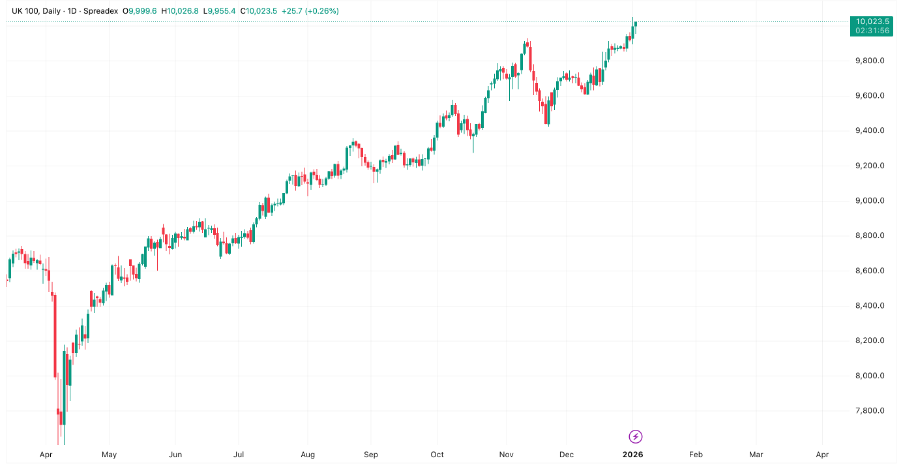
The FTSE 100 has trended upward strongly since April, the month in which President Trump introduced America’s tariff policy. Source: TradingView
Part of the answer lies in timing. The rally came during a thinly traded end-of-year period, when lower volumes can exaggerate price moves. Seasonal optimism, portfolio rebalancing, and expectations of interest rate cuts later this year all played a role. But these factors only explain the momentum, not the deeper disconnect.
The more important explanation is structural. The FTSE 100 is not a mirror of the UK economy. Roughly three quarters of the revenues earned by its largest companies come from overseas. Energy producers, mining firms, defence contractors, and global banks dominate the index. Many of these businesses benefit from higher commodity prices, geopolitical tension, or overseas growth even when domestic conditions are weak.
Meanwhile, the UK economy continues to struggle with subdued productivity, high borrowing costs, and stretched household finances. Small and medium-sized businesses, which employ most UK workers, are barely represented in the index. This creates a gap between how markets look and how the economy feels.
Stock markets also look forward. Investors price expected earnings over years, not current economic discomfort. If inflation is easing and rate cuts appear likely, equities can rise even while growth remains slow. The FTSE’s new high therefore says more about global earnings exposure and expectations of easier financial conditions than it does about everyday economic reality in the UK.
BYD Overtakes Tesla in Global EV Sales
BYD overtaking Tesla in global electric vehicle sales marks a significant shift in the EV market. In 2024, BYD delivered 2.26 million electric vehicles, surpassing Tesla’s 1.63 million (The Guardian), reflecting a transformation in how the industry is evolving.
BYD’s advantage lies in cost control and scale. The company is vertically integrated, producing its own batteries, semiconductors, and key components. This allows it to keep prices low while protecting margins, a crucial advantage as EV demand growth slows and competition intensifies. Tesla, by contrast, built its success on technological leadership and brand appeal, with profitability relying on premium pricing and rapid expansion.
Domestic Chinese demand has also played a central role. Strong state support, extensive charging infrastructure, and industrial policy have helped create a vast home market where firms like BYD can scale quickly. That scale is now being exported, putting pressure on global competitors.
Price competition is becoming more aggressive worldwide. As subsidies fade and consumers become more price-sensitive, margins across the industry are tightening. This environment favours manufacturers with deep supply chain control rather than those built primarily on growth narratives.
There is also a geopolitical dimension. China’s dominance in EV supply chains, batteries, and rare earths has implications for trade policy, energy security, and industrial strategy in the US and Europe. For Western automakers and investors, the EV transition is entering a more competitive phase where execution, cost discipline, and supply chain resilience matter more than vision alone.
💼 Unpacked
US-Venezuela Background
Relations between the US and Venezuela have been strained for years due to concerns over democracy, human rights, and control of Venezuela’s oil industry. US policy has focused on limiting the Maduro government’s access to global finance and energy markets, making Venezuela a recurring flashpoint in energy geopolitics.
Sanctions
Sanctions are economic restrictions imposed by governments to influence another country’s behaviour without using military force. They often limit trade, financial flows, or access to technology. While sanctions aim to apply political pressure, they can also disrupt global supply chains and raise prices, particularly in energy and commodities.
Vertical vs Horizontal Integration
Vertical integration means a company controls multiple stages of its supply chain, from inputs to final products. Horizontal integration involves expanding within the same stage of production, often by acquiring competitors. Vertically integrated firms tend to have better cost control, while horizontally integrated firms focus on scale and market share.
📣 Support The Fiscal Compass
If you found this breakdown useful, consider sharing it with someone who follows the economy, but wants a clearer sense of what’s really going on. You can subscribe to The Fiscal Compass for more analysis like this, and follow along on social media for shorter updates, charts, and explainers between posts.
Instagram: @thefiscalcompassofficial
X (Twitter): @FiscalCompass
LinkedIn: Vinay Meisuria