

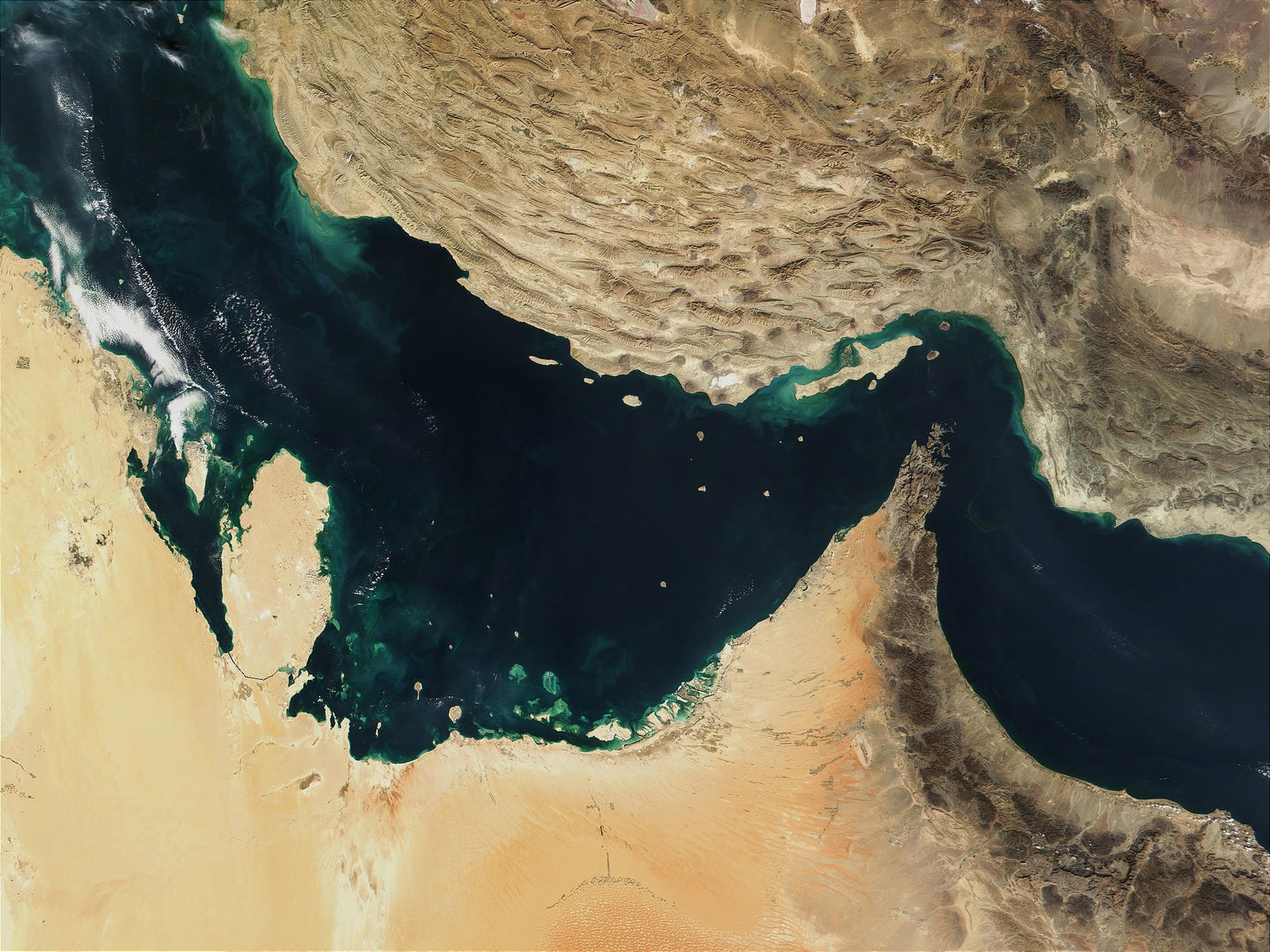
When tensions rise in the Middle East, oil markets are quick to react. Prices move higher, shipping companies reconsider routes, and policymakers begin to worry about the consequences for inflation and economic stability. The trigger behind these reactions is often not the scale of the conflict itself, but where it is happening. In recent weeks, renewed tensions involving Iran have once again drawn attention to one of the most strategically important waterways in the world, the Strait of Hormuz.
The strait sits between Iran and Oman, forming the only sea route that connects the Persian Gulf to the open ocean. Despite being relatively narrow, it carries a remarkable share of the world’s energy supply. Estimates suggest that roughly 20 million barrels of oil and petroleum products move through the strait every day, equivalent to about one-fifth of global oil consumption. Much of the crude exported by Gulf producers such as Saudi Arabia, Iraq, Kuwait and the United Arab Emirates must pass through this corridor before reaching refineries and consumers across Asia, Europe and beyond.
For global energy markets, this means that a single maritime passage plays a disproportionately large role in keeping supply flowing. When tensions escalate near the strait, even the possibility that shipping could be disrupted is enough to push prices higher. The situation illustrates a broader feature of the modern global economy that is often overlooked. Trade may span continents and involve countless companies and supply chains, but the physical movement of goods frequently depends on a small number of geographic bottlenecks. Understanding why those chokepoints matter helps explain how a local conflict can quickly become a global economic concern.
The Strait of Hormuz and the current conflict
The significance of the Strait of Hormuz stems from both geography and the concentration of energy production in the Persian Gulf. The world’s largest oil reserves are heavily clustered in this region, and exporting that energy to international markets requires tankers to pass through the narrow passage connecting the Gulf to the wider ocean. According to shipping and energy data, the strait handles a substantial share of global petroleum trade, including crude oil, refined fuels and large volumes of liquefied natural gas shipped from Qatar.
Recent developments have highlighted just how sensitive this route can be to geopolitical tension. Shipping companies have reduced traffic through the strait after attacks on vessels and reports of naval mines in the area, while international naval forces have been deployed to secure safe passage. Even when ships continue to move through the corridor, insurance costs and risk premiums tend to rise sharply when the security situation deteriorates. These higher costs are often reflected in the price of the cargo being transported.
Energy traders closely monitor these developments because oil markets respond not only to actual supply disruptions but also to the risk that supply might be interrupted. When the security of a key transport route becomes uncertain, traders must consider scenarios in which tankers cannot pass through the corridor at all. In such circumstances, global oil supply could temporarily fall by several million barrels per day. Even if that worst-case scenario never materialises, the possibility alone is enough to influence prices.
Another reason the strait carries such weight is that alternative export routes are limited. Some Gulf producers have built pipelines that allow a portion of their oil to bypass the passage and reach ports outside the Persian Gulf. However, these pipelines cannot handle the full volume of exports normally shipped through the strait. If maritime traffic were severely restricted, a significant share of global oil supply would struggle to reach international markets.
The result is a system where a narrow maritime corridor plays an outsized role in determining global energy stability. When tensions rise near the Strait of Hormuz, markets react not simply because of regional politics but because so much of the world’s energy trade relies on that single passage.
The Waterways the Global Economy Depends On
Although the Strait of Hormuz is currently receiving the most attention, it is only one example of a broader pattern within global trade. The modern shipping system relies on a series of narrow passages that connect major oceans and allow goods to move efficiently between continents. These routes form the physical infrastructure of globalisation, enabling vast volumes of commodities and manufactured products to travel across the world.
One of the most prominent of these corridors is the Suez Canal, which links the Mediterranean Sea with the Red Sea. The canal provides the shortest maritime route between Europe and Asia, allowing ships to avoid travelling thousands of miles around the southern tip of Africa. Roughly 12 percent of global trade passes through the canal each year, illustrating how much commercial activity depends on a single engineered waterway.
Just south of the canal lies another strategic passage, the Bab el-Mandeb. This narrow strait connects the Red Sea to the Gulf of Aden and serves as a gateway for vessels moving between Europe and Asia through the Suez Canal. Oil shipments from the Middle East heading toward Europe often pass through this route before entering the Mediterranean.
Further east, the Strait of Malacca plays a similar role for trade between the Indian Ocean and the Pacific. The strait handles enormous volumes of cargo moving between the Middle East and East Asia, including large quantities of crude oil destined for major importing economies such as China, Japan and South Korea. Because these countries depend heavily on imported energy, the stability of this route is crucial for their economic security.
Across the globe, another important shortcut exists in the Panama Canal. By connecting the Atlantic and Pacific oceans, the canal allows ships to avoid travelling around South America. It supports a large share of trade between Asia and the Americas and significantly reduces shipping distances for many routes.
Taken together, these passages illustrate how goods may originate from thousands of different producers and move through a complex network of supply chains, but the physical movement of those goods often converges in a handful of geographic corridors. Oil, natural gas, agricultural commodities and manufactured products all rely on these routes to reach international markets.
This concentration brings enormous efficiency. Shipping companies can move cargo quickly between major trading regions, and businesses can source materials and products from across the world. At the same time, it creates points where disruption can ripple through the entire system. When a ship blocks a canal, a conflict threatens a strait, or environmental conditions restrict access to a route, the consequences extend far beyond the immediate location.
How a Local Conflict Becomes a Global Economic Problem
The reason these chokepoints carry such global importance is closely tied to the way energy markets operate. Oil and natural gas remain central to modern economies. They power transportation networks, generate electricity, heat homes and serve as key inputs for industries ranging from chemicals to agriculture. Despite the rapid growth of renewable energy, fossil fuels still account for a large share of global energy consumption.
Energy production is also unevenly distributed around the world. Large reserves of oil and gas are concentrated in a relatively small number of regions, particularly the Middle East, North America and parts of Eurasia. Many major economies do not produce enough energy domestically to meet their needs, which forces them to rely heavily on imports. Europe imports large quantities of oil and gas from abroad, while countries such as Japan and South Korea depend almost entirely on imported energy. Because of this imbalance between where energy is produced and where it is consumed, vast quantities of fuel must be transported across oceans each day. Tankers carry crude oil from the Persian Gulf to refineries in Asia, Europe and other regions. In fact, around 84% of crude oil shipments moving through the Strait of Hormuz are destined for Asian economies, underscoring how strongly many of the world’s largest economies depend on energy imported from the Gulf.
When a conflict threatens one of these passages, the consequences can spread rapidly through the global economy. The first reaction usually appears in commodity markets. Traders anticipate the possibility that supply could be disrupted and adjust prices accordingly. Oil prices may rise even if production remains unchanged, simply because the risk of interruption has increased. This process reflects the forward-looking nature of financial markets, where expectations about future supply and demand shape current prices.
Higher energy prices then begin to affect the wider economy. Fuel costs influence transportation expenses for airlines, shipping companies and trucking firms. As these businesses face higher operating costs, those increases can eventually filter through to the prices consumers pay for goods and services. Energy prices also play a direct role in inflation because they affect household spending on fuel, heating and electricity.
Central banks and governments therefore monitor developments around energy chokepoints closely. A sudden spike in oil prices can complicate efforts to control inflation or support economic growth. Policymakers may find themselves balancing the need to stabilise prices with the desire to avoid slowing the broader economy.
The importance of these routes may become even more pronounced as several structural trends unfold. Geopolitical tensions have intensified in multiple regions where key shipping corridors are located, raising the possibility that strategic waterways could become flashpoints in wider conflicts. Climate pressures are also beginning to affect global shipping infrastructure. Periods of drought have already limited traffic through the Panama Canal by reducing water levels needed to operate its locks, forcing authorities to restrict the number of vessels that can pass through each day.
At the same time, global supply chains remain deeply interconnected. Although some countries have attempted to bring manufacturing closer to home in recent years, international trade still underpins the production of many goods and the supply of essential resources. Energy imports continue to link economies across continents, ensuring that events in distant maritime corridors can influence domestic economic conditions.
Lessons from the Conflict
The tensions surrounding the Strait of Hormuz offer a reminder that the foundations of global trade are more fragile than they sometimes appear. Waterways that are only a few miles wide carry a substantial share of the world’s energy supply, and as long as countries rely on resources produced far from where they are consumed, these routes will remain essential. The global economy may be vast, but many of its most important flows still pass through a few narrow gateways. When tensions threaten one of them, the effects rarely remain local.
💼 Unpacked
Chokepoint
A chokepoint is a narrow geographic passage, such as a strait or canal, through which large volumes of global trade must pass. Because these routes have limited alternatives, disruptions can quickly affect shipping, commodity prices, and supply chains.
Energy security
Energy security refers to a country’s ability to access reliable and affordable energy supplies. Nations with strong energy security can meet demand without major disruptions or excessive price volatility. Countries often improve energy security by diversifying suppliers and investing in domestic production.
Shipping insurance premiums
Shipping insurance premiums are the fees shipowners pay to insure cargo and vessels against risks such as accidents, piracy, or conflict. When tensions rise along major trade routes, insurers classify areas as high-risk and increase premiums, raising transport costs that can ultimately feed into commodity and consumer prices.
📣 Support The Fiscal Compass
If you found this insightful, consider sharing with friends or colleagues. For weekly economics-led takes on markets, policy, and macro trends, subscribe to The Fiscal Compass.
Follow along on social media for concise updates throughout the week:
Instagram: @thefiscalcompassofficial
X: @FiscalCompass.
LinkedIn: Vinay Meisuria
Sources
Statista chart on maritime oil flows through the Strait of Hormuz
Recent statistics on Hormuz oil transit volumes (EIA/IEA data summary)
Explainer on oil and LNG flows through the Strait of Hormuz (Al Jazeera citing EIA data)
Global oil trade flows through major maritime chokepoints (EIA dataset summary)
Visualised map of global oil chokepoints and volumes
Featured Image: Satellite image of the Strait of Hormuz, the closest point between the two Middle Eastern countries. Source: Wikimedia Commons
_(4996894832).jpg)