

Gold has long occupied a special place in financial markets. Unlike stocks or bonds, it doesn’t pay interest or yield dividends, yet investors have treated it as a kind of insurance policy: something to buy when the future feels uncertain and traditional markets are shaky. Over the past few years that perception was reinforced as gold climbed to record highs, above $5,500 per ounce in early 2026 after a strong rally through 2025.
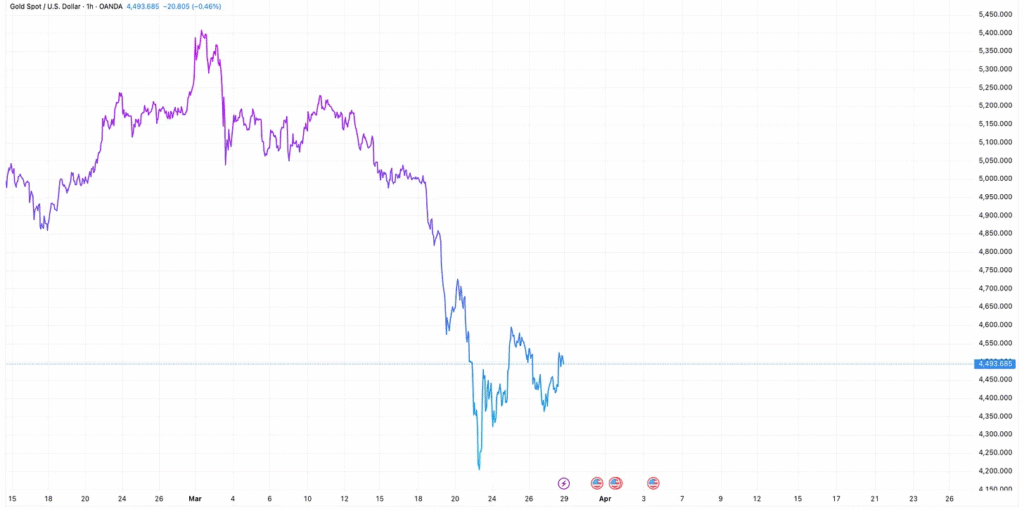
But the price story of early 2026 has confounded many. Despite geopolitical uncertainty, particularly the conflict between the United States and Iran, gold hasn’t behaved like the classic “safe haven.” Instead of rising steadily, it has retreated from its peaks. In March alone, spot prices have fallen roughly 16–20%, one of the steepest monthly drops in decades.
For investors, retirees, and ordinary savers, this raises a clear puzzle: why would an asset that thrives on fear and instability weaken precisely when fear has intensified?
How Is Gold Performing?
For much of financial history, gold has served as the anchor investors reach for when uncertainty looms large. During the Global Financial Crisis (GFC) that began in 2007 and intensified in late 2008, the price of gold climbed sharply. Between 2008 and 2011, gold’s price roughly doubled, rising from around $880 per ounce in late 2008 to above $1,700 by 2011 as markets reeled from banking failures, collapsing credit markets, and plunging stock prices. This surge reflected investors seeking a store of value when confidence in financial assets evaporated. Meanwhile, in more recent history during the COVID‑19 pandemic in early 2020, gold again rallied as global lockdowns and unprecedented central bank stimulus injected volatility and fear into markets. Prices, which had been trading near $1,500/oz in February 2020, pushed above $2,000/oz by August 2020, a record at the time, driven by safe‑haven demand and massive monetary accommodation.
During the Ukraine‑Russia war starting in February 2022, gold’s behaviour was more complex. Initial geopolitical shocks in February and March coincided with the Federal Reserve embarking on aggressive rate hikes to tame inflation, a factor that muted gold’s immediate upside potential relative to past crises. The metal oscillated through that year and into 2023, trading with volatility as interest rate expectations and inflation readings competed for investor attention. Collectively, these episodes illustrate that gold’s price often rises in response to crisis, but the timing and magnitude depend on wider economic conditions and monetary dynamics.
In the lead‑up to 2026, gold experienced a noteworthy rally. According to data and recent market commentary, the precious metal delivered one of its strongest annual performances in recent decades, with prices climbing sharply through 2025. At the end of that year, gold had gained more than 60% year‑over‑year and reached above $5,000 per troy ounce, its strongest momentum in decades amid lingering geopolitical strains and macroeconomic uncertainty. However, this rally has since reversed substantially. This March, gold prices fell roughly 22% from recent highs above $5,400 per ounce earlier in the year, touching levels nearer $4,200 before modest rebounds. This has made March 2026 potentially one of gold’s worst months since the 2008 crisis. So, while gold’s long‑term track record shows clear episodes of strength during crises, the pattern and magnitude vary depending on how monetary policy, currency values, and yield expectations evolve alongside geopolitical developments.
Understanding this historical backdrop sets the stage for exploring what has changed in 2026 and why gold is behaving differently despite ongoing global uncertainties.
Why Is It Falling Now?
In the first quarter of 2026, contrasting forces have acted on gold prices, particularly as markets digest geopolitical tension in the Middle East following conflict involving Iran and broader expectations around monetary policy.
One of the clearest drivers has been the movement in U.S. Treasury yields. Treasury yields, which measure the return investors demand to hold U.S. government debt, have risen sharply this year. Currently (late March 2026), the 10‑year Treasury yield stands above 4.4%, a significant level compared with historical norms and higher than much of the prior year’s trading range. Elevated yields make interest‑bearing assets more attractive relative to gold, which, as a non‑yielding asset, does not generate regular income. For example, yields on the 10‑year note have climbed by more than 40 basis points in March alone, marking one of the largest monthly surges in yields in over 17 months. Meanwhile, shorter‑term yields, such as the 2‑year Treasury, have also jumped, exceeding 3.9% following weak auction demand that required dealers to absorb larger portions of issuance. The result is broader upward pressure on yields across maturities. For borrowers and investors, this translates into higher returns from fixed‑income instruments at a time when gold returns have pulled back.
The movement in yields is closely connected to inflation expectations and monetary policy outlooks. Rising energy prices, particularly oil above $100 per barrel, have driven inflation expectations higher in markets, which in turn has reduced the probability of aggressive near‑term interest rate cuts from the Federal Reserve. With the Fed signalling only one potential rate cut in 2026 and markets pricing in a higher‑for‑longer rate environment, yields have stayed elevated. Higher yields raise the opportunity cost of holding gold, since investors can earn more from U.S. government bonds without sacrificing perceived safety.
At the same time, the U.S. dollar has strengthened modestly in early 2026, particularly against some major peers. When the dollar strengthens, gold priced in dollars becomes more expensive for holders of other currencies, reducing demand and exerting a downward influence on prices. Part of this dollar strength reflects shifting safe‑haven flows, with many global investors seeking liquidity in dollar‑denominated instruments rather than precious metals. Recent market data show the U.S. dollar index rebounded about 2% in early 2026, building off a weaker performance in 2025, and remains significant on a long‑term basis.
Another factor has been portfolio repositioning and profit‑taking after the strong rally of 2025. Investors who had built positions in gold during the metal’s rapid ascent began reducing exposure once prices peaked, particularly as other assets, including cash and bonds, offered higher yields and liquidity. These shifts have coincided with notable outflows from gold‑backed exchange‑traded funds and selling pressure from speculators and institutions responding to changing macro conditions.
Taken together, this combination of rising real and nominal yields, a resilient U.S. dollar, and repositioning by global investors has translated into a materially different price profile for gold in early 2026 compared with past crisis episodes. Rather than rallying steadily in the face of geopolitical risk, gold is being evaluated as part of a broader macroeconomic picture where yield, currency, and inflation expectations interact to shape investment decisions.
Could This Set a Precedent for Safe‑Haven Behaviour?
The debate now among investors centres on whether gold’s latest retreat represents a fundamental change in how safe havens behave or simply a short‑term anomaly driven by market structure and shifting expectations. Some analysis suggests that gold’s counter‑intuitive behaviour this year is not entirely unprecedented when examined closely against the backdrop of interest rate dynamics and currency strength. A report by UBS from 12 March 2026 notes that gold’s performance during geopolitical events has historically been mixed: in earlier conflicts such as the Russia‑Ukraine war and the Gulf War, gold showed initial spikes before giving back much of those gains as other economic forces took hold. Such patterns imply that gold’s role during conflict has always been conditional on broader macroeconomic context, not just the presence of geopolitical risk itself.
More specifically, gold’s price is highly sensitive to the opportunity cost of holding it relative to other assets. When yields on U.S. government bonds rise and the U.S. dollar strengthens, as they have over the course of this year, the incentive for investors to hold yield‑bearing securities or dollar‑denominated cash increases, even in times of tension. In such a regime, gold’s traditional safe‑haven appeal can be muted. This behaviour has been evident in recent weeks, where rising yields and a firmer dollar have coincided with significant gold price corrections.
For individual investors, the central question becomes how to interpret this behaviour in a way that informs practical decisions. “Safe haven” should not be understood as a guarantee that gold will always rise in every kind of uncertainty. Instead, gold’s performance depends on how different parts of the market price risk, liquidity, and return potential at any given time. In some instances, particularly when credit or liquidity stress is acute, cash and treasuries may act as the first stop for investors. Gold’s price can decline initially even as uncertainty rises, partly because investors sell positions, including gold, to meet liquidity needs or to reposition into assets that currently offer positive returns.
Gold’s role as a safe haven is more conditional and nuanced than many investors assume. The precious metal clearly still retains a place in long‑term portfolios as a form of protection against certain types of systemic risk and inflationary pressures, but its short‑term reactions in an environment of strong yields and a resilient dollar may differ from past crisis patterns. That nuance influences how ordinary savers and investors should think about risk management and asset allocation in an era of heightened macroeconomic volatility.
In practical terms, this could mean several things for an everyday reader. Gold may still act as a valuable portfolio diversifier over time, especially if inflation persists or if debt levels and geopolitical tensions create pressure on fiat currencies. But expecting gold to rise automatically whenever uncertainty spikes is likely to be misleading. Instead, investors need to consider a broader set of market signals, including yield trends and currency movements, when deciding how much exposure to allocate to gold or other traditional safe havens.
💼 Unpacked
Opportunity Cost
Opportunity cost refers to what you give up when choosing one option over another. In investing, it’s the return you miss by not putting your money elsewhere. For example, holding gold means forgoing interest from bonds or savings. When interest rates rise, the opportunity cost of holding non-yielding assets like gold increases.
Treasury Yield
A Treasury yield is the return investors earn from lending money to the U.S. government by buying Treasury bonds. Gilts are the British version. Yields move based on expectations around inflation, interest rates, and economic growth. Higher yields make bonds more attractive to investors.
US Dollar Index (DXY)
The U.S. Dollar Index measures the value of the U.S. dollar against a basket of major currencies, including the euro, yen, and pound. When the index rises, the dollar is strengthening. Because gold is priced in dollars, a stronger dollar makes gold more expensive for international buyers, which can reduce demand and push prices lower.
📣 Support The Fiscal Compass
If you found this insightful, consider sharing with friends or colleagues. For weekly economics-led takes on markets, policy, and macro trends, subscribe to The Fiscal Compass.
Follow along on social media for concise updates throughout the week:
Instagram: @thefiscalcompassofficial
X: @FiscalCompass.
LinkedIn: Vinay Meisuria
Sources
Gold price data, Trading Economics
Gold price chart, TradingView
Global markets Q1 2026 analysis, Reuters
US 10-year Treasury yield, Trading Economics
Market commentary, February 2026, World Gold Council
Gold outlook and demand, JPMorgan
Featured Image: National Gold Reserve